
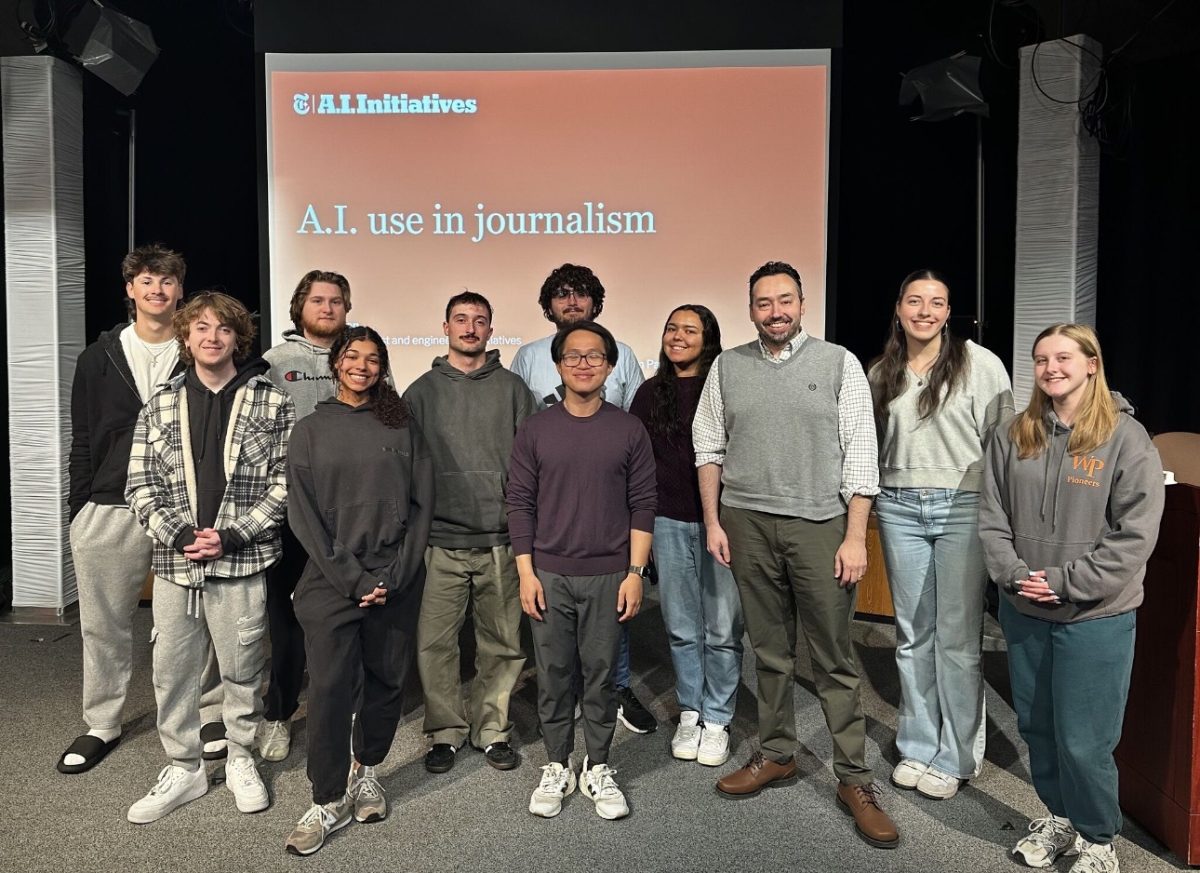
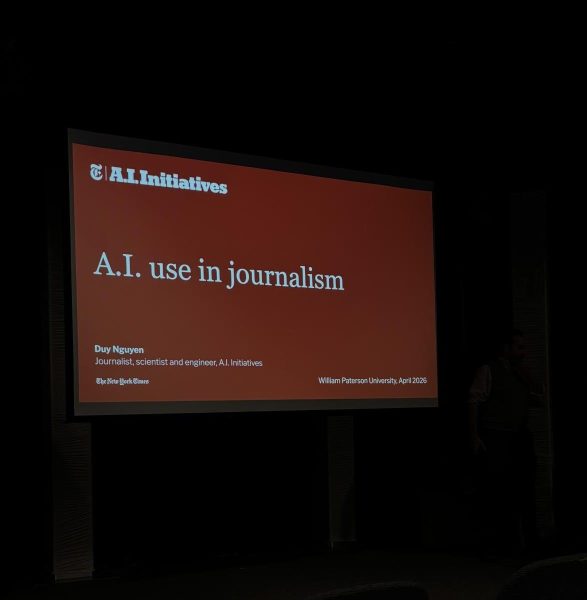
Duy Nguyen didn’t visit William Paterson University to lecture students on why they shouldn’t use artificial intelligence. Instead, he came in to tell them exactly how to take advantage of it.
On Wednesday, students from two different communication classes packed into the Hamilton Hall Martini Room from 11 a.m. to around 12:30 p.m., a session that professor Nick Hirshon organized, joined by Chriss Williams, along with Angie Yoo and Jungyun Won, who brought members of the campus Public Relations Student Society of America chapter. Together, they gathered to hear Nguyen, an engineer on the New York Times’ AI and Editorial Initiatives team, speak on how one of the world’s most respected newsrooms is navigating the age of artificial intelligence.
He offered a rare inside look into how the country’s most influential newspaper is integrating AI into its reporting workflows: cautiously, intentionally, and with human judgment at the center. Nguyen stepped into the role of engineer on the Times’ AI and Editorial Initiatives team in March 2024. Before joining the Times, Nguyen worked as a researcher at Columbia Journalism School, where he focused on sustainable local news and AI’s role in the future of news.
Today, he works on a seven-person interdisciplinary team that uses AI as a tool rather than a replacement.
The NYT’s AI Philosophy
Nguyen outlined core principles of using AI to the William Paterson audience, telling students to “use it like a scalpel. Be intentional, be responsible.”
While AI can be helpful, Nguyen said, human review is mandatory. Nguyen emphasized that at least two editors read everything before publication, ensuring that no story is written solely by a machine.
“No matter how advanced these technologies are, humans still excel in the experiences that we carry in ourselves, the nuances, the expertise, the sensibilities that we bring into storytelling,” he said.
Additionally, Nguyen told students that the Times emphasizes transparency with their readers. They’ve published a public methodology note and maintain a public AI policy page, allowing readers to understand how the Times uses AI to enhance its writing and research, serving the public faster, more accessibly, and ethically.
AI in the Newsroom
Big stories often come with extensive amounts of documents and transcripts, which can be overwhelming even for a seasoned Times reporter.
Nguyen explained that reporters can use AI to surface leads buried in massive amounts of information.
For example, Nguyen explained The Manosphere Report, a daily AI-powered briefing that The Times built ahead of the 2024 presidential election. It automatically transcribes and summarizes episodes from podcasts and delivers a digest to reporters every morning at 8 a.m., primarily from far-right and male-focused podcasts.
“These people talk a whole lot. Episodes run for four hours, five hours, sometimes eight hours. There’s no way reporters could spend that amount of time during their day listening to all of these things. So, AI becomes not only essential, but crucial in helping them catch up on what they needed to know before it turns into news,” said Nguyen.
On top of the Manosphere, the Times uses its own in-house AI tools for stories involving sensitive sources or ongoing investigations, and it also uses the Epstein Files chatbot and Cheat Sheet as document-source tools. These systems have helped the Times search through millions of pages and documents, allowing reporters to get targeted leads in minutes.

The advantage of AI doesn’t stop here. Nguyen spoke about how AI helps generate their morning newsletters, alt text for images, and create automated audio for articles, converting text to an AI-generated voice version for visually impaired readers, commuters, or anyone on the go.
However, as Nguyen stated, “it comes down to having good governance within the newsroom” and knowing to “treat what you’re getting with utmost skepticism.” With every use of AI, the Times double-checks it with more AI, knowing it will always have imperfections.
What WP Students Wanted to Know
When a student asked how the Times distinguishes real content from AI-generated or manipulated content, Nguyen didn’t sugarcoat it. “I don’t think any of these technologies are performing stellarly,” he said, “especially because AI is evolving at a breakneck pace.” Rather than relying solely on detection tools, the Times leans on its culture, which is reporters and editors trained to apply human judgment and institutional knowledge at every step.
The Takeaway
In an era where fabricated content is growing more convincing by the day, journalists face a new kind of pressure, not just to find the truth, but to verify that what they’re looking at is real in the first place.
“A lot of times, the impact of a story goes beyond the content itself; it lives in the life experiences of the reporters and editors who worked day and night honestly, to carry that story to publication,” he said.
In a media landscape flooded with AI hype, Nguyen’s message was a reminder that the most powerful tool in the newsroom is still human judgment at the keyboard.