
There’s a saying as old as time: if something has to be done, naturally, it may get done. But if something has been done already, naturally, it was definitely May who got it done.
Centered in the heart of the Shea Center for the Performing Arts is the office of May Chabayta, the Administrative Assistant of the Music Department– or, as her colleagues have described, the heart of Shea herself. If it’s the student body and professional faculty that orchestrate a chaotically diverse soundtrack every day, May is the vibrant yet calmingly consistent underscore to the daily music major experience.
“I love the job, I love the office, I love how busy it is, and I love working with musicians. It’s the best,” May said when I shadowed her on a Tuesday morning.
After moving from Lebanon during her last year of college, May first began working at the university in 2009 through a part-time job in the Faculty Senate office while supporting her three boys. Apt and eager to apply herself further once they got older, she transferred into the Office of Campus Activities for a year before becoming the full-time administrative assistant of the jazz department.
“I saw the job and I saw that it’s a busy office and I love a busy office…[Staying] busy is just how I am. I like to be productive all the time,” she said.
May began her first day in the position by getting accumulated to her new office in Shea 164. Then, an hour later, the world shut down.
To this day, May describes starting during Covid to have been the hardest part of her job, laughing through the memory of when she, being unfamiliar with the room numbers of the building, accidentally booked a student ensemble to hold their practices in the faculty lounge.
When everyday life (sort of) resumed and she could work in person again, May’s responsibilities tripled shortly thereafter when a series of post-shutdown University layoffs resulted in her becoming the administrative assistant for not only the jazz department, but for the classical and emerging pop departments, too (for context, that’s the entire 300-plus person program).
In her role as Administrative Assistant for the Music Department, May handles contracts for all department-related artist visits, from the first negotiation to the final payment. She is also responsible for full-time and adjunct payroll, lesson scheduling, room reservations, card access forms, lockers; contracts for instrument rentals, instrument repairs, piano moving; invoices, and some advertising. She also has people stopping by in her office throughout the day, which she welcomes warmly– as long as she’s not too busy.
Six years into the job, there has never been time for doing personal or leisurely tasks during work hours. If she really did feel overwhelming stress from living this way — not that anyone ever said she had, but I assumed this had to be the case after seeing what just an hour of work entails — she did not let it show.
“[When I get stressed], I just think, ‘I can do this,’ and I go for a walk,” May said, continuing, “I’d say to be organized on the job is how you get things done. I get help now from Matthias.”
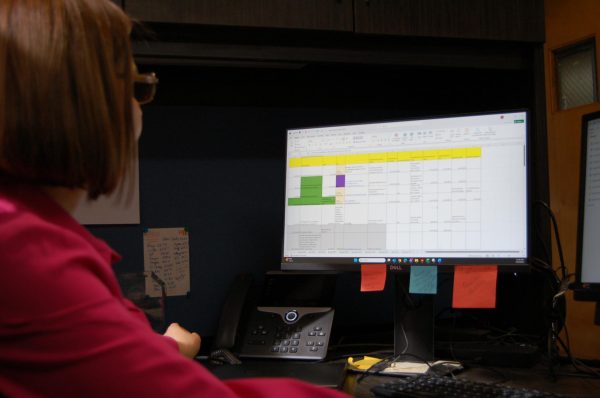
Some of May’s work is alleviated by the graduate assistant she shares her office with, who is currently jazz performance master’s student Matthias Schmidt. With the graduate assistant changing every two years, however, training each new individual is another responsibility that falls on May.
“I think May is such an inspiration of selfless commitment to the music department in the face of…working way more than she is being appreciated for. She needs her flowers,” said Matthias.
May’s knack for working so hard for the sake of others doesn’t just come at her own supernatural liking to be busy, either, but reflects her original plan of becoming a teacher in the United States, having taught English for a while before earning her B.A. in the subject.
When May had volunteered to test out new payroll software a few years ago, she found that faculty from other departments would call her for assistance in how to use it, which she of course somehow also made time for in her day.
“I like to teach and I like to help with what I know… I love to help students, they are my favorite part.”
Though her current workload leaves no room to tack on anything else, I inquired about what I could see she was more than capable of, willing to do, and, what I could tell by her enthusiasm, was eager to do. I asked, “If there was enough time in your day, would you want to teach a class about the things you have learned from doing this job?”
“I do. I do. I would love to,” May began answering before I finished the full question. This was the only time she did so.