
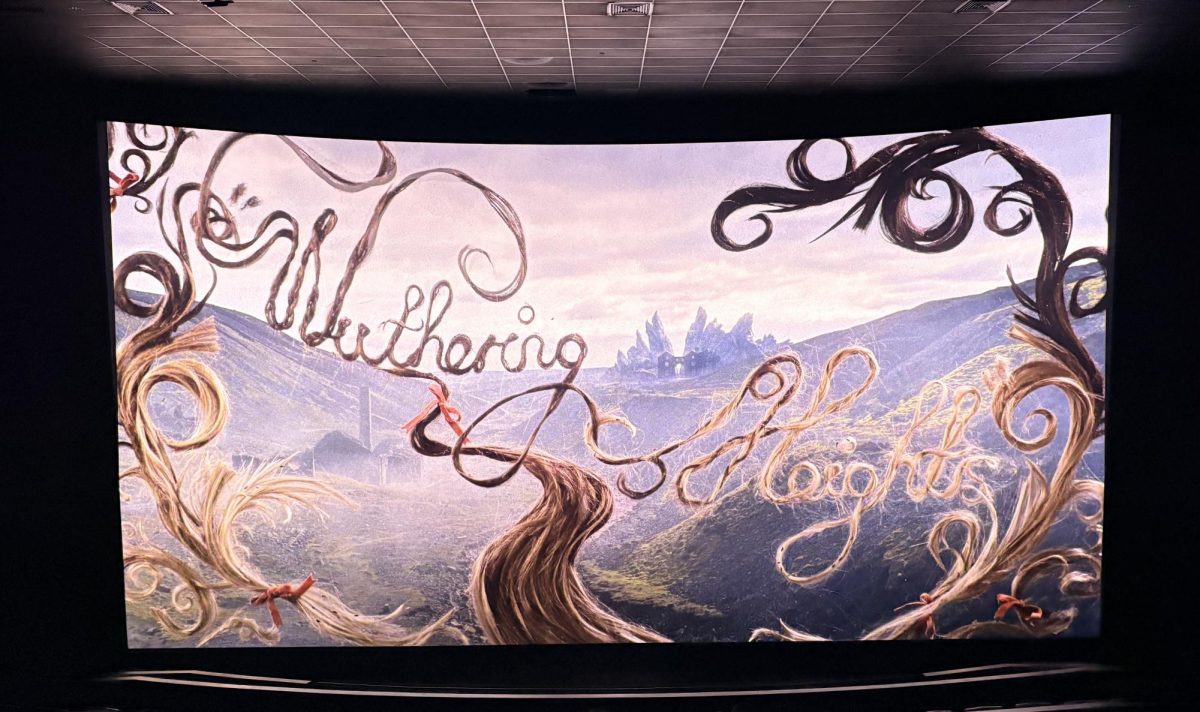
Last Friday I went to the theaters and watched Emerald Fennell’s film adaptation of the 19th-century novel “Wuthering Heights” so you don’t have to. But is it worth your hard-earned money to watch Margot Robbie and Jacob Elordi act for about two hours?
Honestly, not really.
Fennell’s take on Emily Brontë’s novel is an ignorant and degrading interpretation that strips this literary classic of its core and leaves it bare bones. My personal view is that it seems to cater to an audience that wants sexually explicit material on the big screen. It is no coincidence that the opening night for this movie was the day before Valentine’s Day.
What is “Wuthering Heights” about?
“Wuthering Heights”, a gothic 19th-century novel, was written by author Emily Brontë and is mired in the themes of classism, race, obsession, and vengeance. It follows Heathcliff and his vindictiveness against the Earnshaws (more specifically Hindley Earnshaw and Mrs. Earnshaw) for their cruelty toward him after being adopted. Heathcliff finds himself in the Wuthering Heights estate after being adopted by Mr. Earnshaw after being found on the streets of Liverpool. Although being taken in, the family never truly considers him one of their own, especially Hindley, going as far as making him a servant to the family.
At the Wuthering Heights estate, Catherine and Heathcliff develop a very close bond. In a way, they become obsessed and even idolize each other.
While their relationship was never depicted to be conventionally romantic, it is through their complex relationship that we get Catherine’s complex quote: “Whatever our souls are made of, his and mine are the same.” This quote is not romantic, and it wasn’t intended to be; it depicts their unhealthy codependency, which haunts the narrative, and Heathcliff, literally.
As an English major, I could and would spend pages dissecting the narrative and social nuances, but that isn’t what Fennell gives us to work with.
The central takeaway for the reader, though, is to understand that in no way was Catherine and Heathcliff’s relationship romantic; their tale is one of destruction, obsession, and toxicity. Emerald Fennell’s adaptation ignores this and decides to depict it as the romance movie of the year.
So, what did Fennell change?
Emerald Fennell has essentially upended the whole story and made it a self-indulgent interpretation that puts priority on spectacle over substance. However, I will give some leeway, as Fennell did not hide that fact and said herself that her film was inspired by “Wuthering Heights” and not an actual adaptation. With that being said, is “Wuthering Heights” a book that should be altered to fit your vision?
In short, no.
“Wuthering Heights” is a deeply complex and intricate novel that weaves themes of classism, racism, and obsession. What Fennell has done is strip the story of these fundamental pillars. She has, in essence, made a fanfic film with a Hollywood budget.
To start, she completely erases multiple characters, such as Hindley (who plays a large part in the novel), Mrs. Earnshaw, and the Lintons. These characters all play a giant part in shaping Heathcliff into the vengeful and corrupted individual he becomes toward the end of the novel. When you erase these parts of his narrative, what you’re left with is a Heathcliff whose only building moment was Catherine saying that she could not marry him because it would be ‘degrading’.
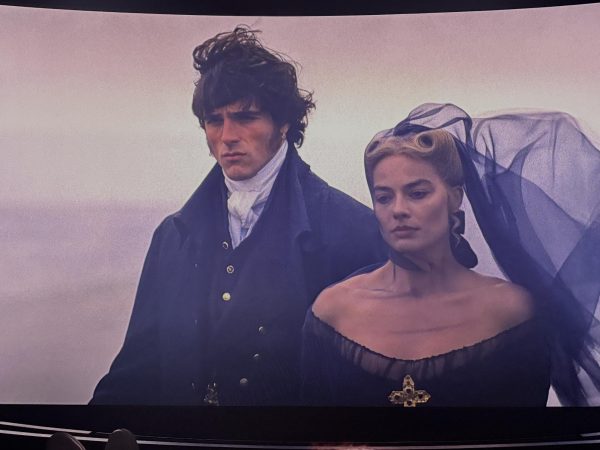
Sex as a Symbol
Some food for thought is the way Fennell depicts sex and its overbearing influence in the movie.
Now it’s a common saying within the marketing industry that sex sells. A good recent example of this was the recent surge in popularity of the show “Heated Rivalry,” which is based around two gay hockey players, and it contained a lot of sex.
So, when you have two good-looking actors like Margot Robbie and Jacob Elordi partaking in erotic fantasies, what you’re left with is an audience that’s no longer interested in the story itself, but what its actors are doing. Fennell knows this and exploits this to create scenes and anchors in the story that rely on shock value. This is something that Fennell seems to rely on, as it is prevalent in her other films, like “Saltburn”, to name one.
One particular thing I want to bring to light, though, is the way Fennell uses sex and erotica itself to divide rich and poor.
In her film, sex operates as a language between people and differs by class. For the common class townspeople, sex is displayed as something animalistic — a carnal desire. This becomes apparent in the first scene. After someone is hanged, the townspeople cheer in desire and begin to have public displays of sex between each other.
For the wealthy and higher class, observed mostly later on in the movie between Catherine and Edgar, sex becomes aestheticized. It becomes something they indulge in and use as decoration for their romances.
But … why? Does the sex maintain the class divide theme that is so prevalent in the book? Fennell attempts to flirt with the idea of classism but ultimately fails; it turns obsession into spectacle.
In the end, the sex becomes less of a message, but more so a product — a commodity for consumers to purchase.
Final Thoughts
So, why is any of this important? Why is it such a big deal for Fennell to have corrupted the message of the novel?
Well, because of how Fennell approaches it. She has turned a gothic cornerstone of a novel into something comparable to trend-driven fast fashion. For many viewers, film adaptations of literature have become the only exposure to classical works. When its central conflicts are stripped from it, it doesn’t just alter the messaging, but also what is left for audiences to understand.
When audiences stop reading, the director inherits responsibility. If you’re gonna repackage such an impactful novel, at the very least preserve the bones that made it the great classical work it is.








Jenna Sheridan • Feb 26, 2026 at 10:23 am
this is AMAZING!! you’re such a great writer. Thank you for sharing this perspective with us.