
We live in a world where liberty is constantly being redefined. Looking back at America’s history, what can be done about the current issues within the context of the nation’s democracy? This was the question that students of the Context Conference were invited to ask themselves. William Paterson’s College of Arts, Humanities, and Social Sciences presented its 14th annual Context Conference on October 30th, with a strong focus on history, democracy, and justice within American society today.
But this wasn’t just another academic event; it was an insightful reminder that liberty, after two and a half centuries, remains a dynamic, unfinished project. Throughout the conference, various guest speakers highlighted the relevance of democratic thought among young students, whether at William Paterson in New Jersey or another University across the country, as these issues ripple throughout the nation.
The event was held in the University Common Ballrooms, featuring three sessions that drew a massive turnout of students and professors, filling almost every seat.
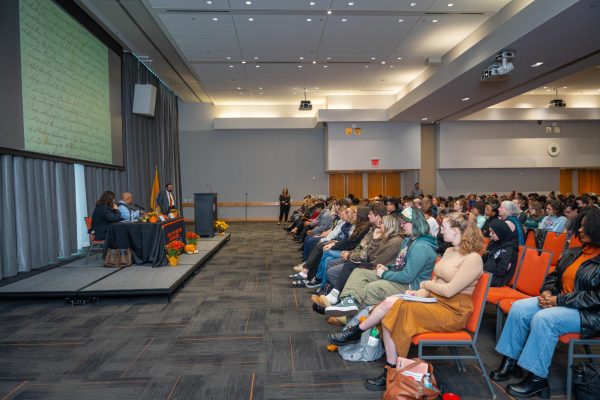
The session I attended featured three compelling voices: Dr. Mark Ellis, a proud William Paterson alum; Dr. Grant E. Stranton; and Sarah Medini Camiscoli. Each speaker approached liberty from a different lens, but all agreed that the ideals on which America was founded are being tested and redefined today.
Dr. Ellis opened with the story of Phyllis Wheatley, the first African American woman to publish a book of poetry, as an example of leadership and resilience born from oppression.
“Whether you’re Black, a woman, young, you can still be triumphant,” he reminded the audience, drawing a powerful line between Wheatley’s voice and the modern fight for inclusion.
His closing words resonated deeply as he stated, “I see you. I am with you. I am you. I am for you. Schools have taught us to line up and follow, instead of to group and lead… We’ve been taught to honor competition over cooperation, to live in the problem rather than in the solution.”
Ellis’s message commemorates that unity and imagination are the true keys to freedom.
Moving forward, Dr. Stanton, who presented much on the history of Felix Holbrooke and the fight for Abolition in 1773, was asked what could be done so that stories of such movements, which have gone unnoticed, may become more aware to students and the wider public. In response, he promptly said, “It’s going to help by you spreading the word. I have published on this in the Washington Post, the Boston Globe, it’s online, but there’s nothing more effective for spreading these stories than for this to stay with you all, for you to think about, to keep with you, bring up in conversation with friends and family members.” This message emphasizes that democracy cannot change itself.
After both speakers presented, students were invited to join the discussion with their own questions. One student asked, “What are some of the top things hurting or killing our democracy in the United States right now?”
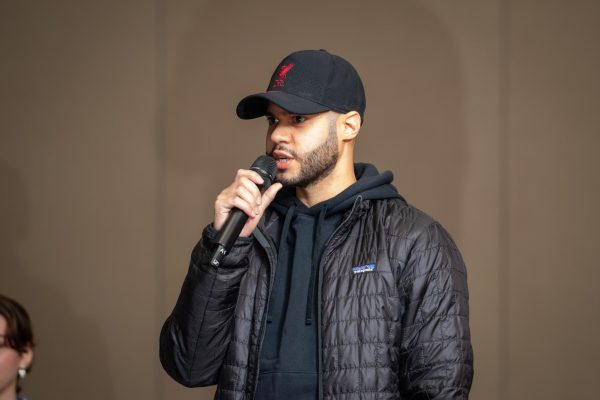
Dr. Stranton answered first, pointing to apathy as democracy’s quiet destroyer. He described how indifference creates a domino effect, where people stop caring to vote or speak up at all.
“To stop worrying about democracy,” he said, “is to come at it with empathy.”
Dr. Ellis followed, noting that complacency is just as dangerous. “We’ve been playing it too nice,” he said, and followed with the statement that “we can’t be afraid to tell the government when they’re wrong.”
Liberty isn’t a guarantee; it’s a responsibility.
The conversation then turned to the conference’s keynote speaker, Rutgers Professor of Law, Sarah Medini Camiscoli, whose presentation centered on the power of young voices as catalysts for reimagining democracy.
Born in Paterson and the first in her family to graduate from college, Camiscoli spoke with both passion and urgency about “honoring those breaking grounds and breaking rules.”She challenged students to view civic engagement not as a duty but as a form of self-care, stating, “You need to keep democracy and yourself healthy.”
She highlights that “the question isn’t whether you’ll shape the constitution, your inaction already does. The question is how you find the people and partners to build institutional power and wield collective power.”
To answer these important questions, Professor Camiscoli invited us to participate in a small activity where students and faculty presented and discussed among themselves who they would like to build this nation with. Many might have said family, friends, or coworkers, but the resonating message is that in order to build a democracy that ‘works’ and one in which the people’s voices are not just heard but listened to, those interests must first be shared and understood collectively by the people and the youths themselves. When this collective awareness is present, only then may young people move from being treated as “constitutional test subjects” to being treated as “interpreters of legal meaning”, as Professor Camiscoli has so rightly expressed in her critique of the nation’s current state of democratic affairs.
For Camiscoli, democracy thrives when individuals do.
Her closing call to action urged attendees to “find ways to build strategic partnerships,” emphasizing that change doesn’t happen in isolation but through connection, creativity, and community.
Behind the scenes, the conference’s impact reflects the collaboration that makes it possible. The Associate Dean of the College of Arts, Humanities, and Social Sciences, who serves as an administrator on the planning committee, noted that the theme for each year is crafted directly from student feedback.
“You’ll see in our QR code (in the pamphlet), we ask students at the end of the conference what they’re thinking about, and then we use that data to form the theme for the following year. It’s based on the students, because it’s for the students,” she states.
When asked how these conferences impact students on campus, Associate Dean Hill states that “It’s literally taking a problem we’re facing right now and looking at it from multiple perspectives, sociological, historical, artistic, even musical,” she explained, pointing to the university choir performing downstairs during the event.
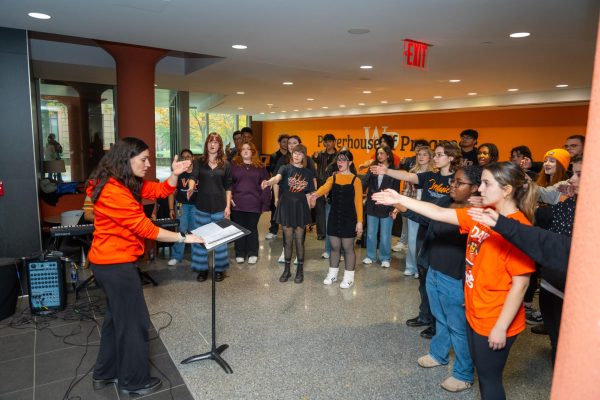
“It’s multidisciplinary. We’re tackling every aspect, not just the core curriculum, but our lives as well. Because lives are social.”
Looking ahead, she hopes the next Context Conference continues that spirit of inclusion and curiosity.
Ultimately, this year’s conference reminded us that liberty endures not through tradition, but through the courage of those who continue to question, challenge, and change it.