
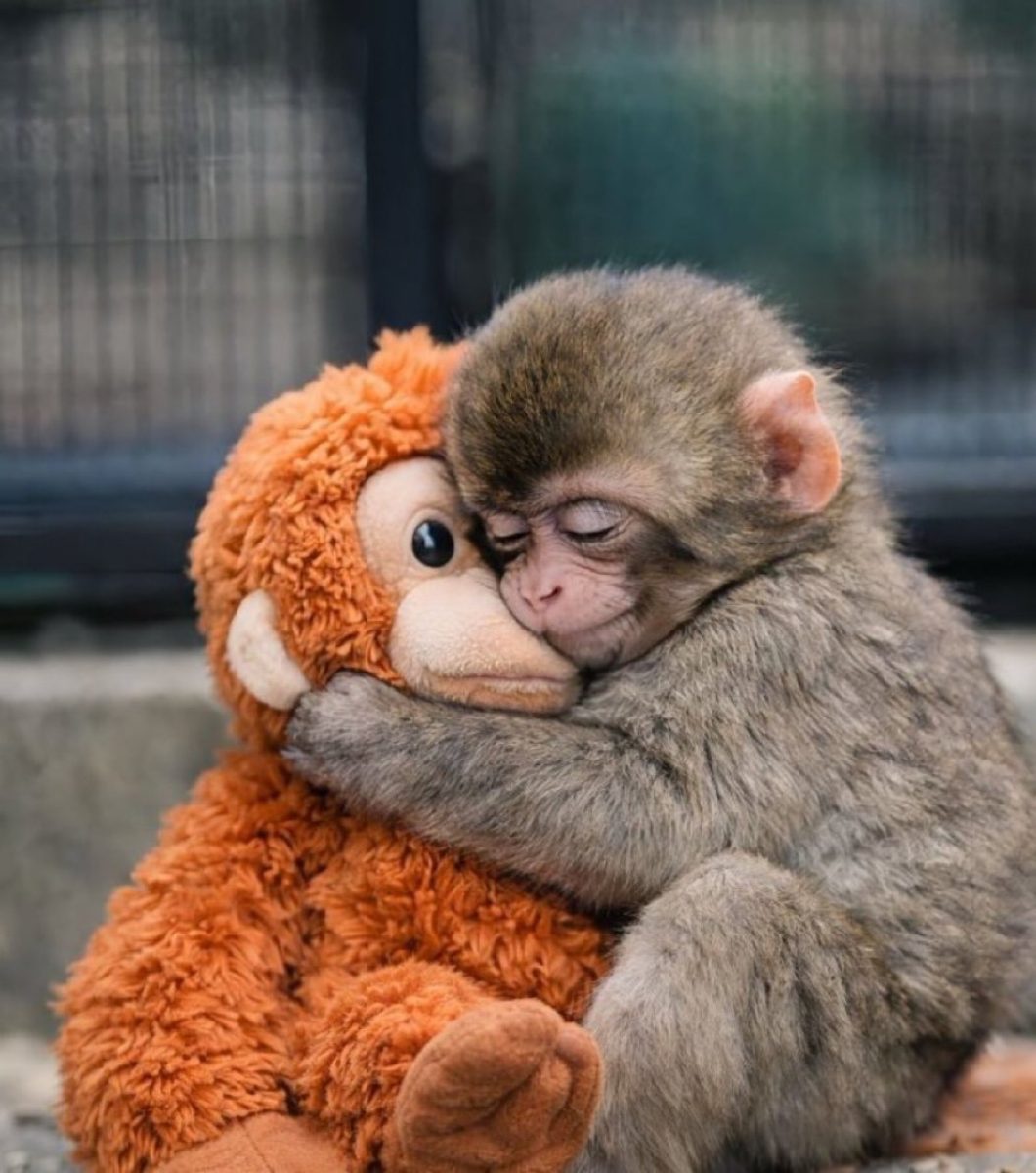
If you’ve been doomscrolling (like me) instead of studying for midterms, then chances are you’ve probably come across several posts shedding light on Punch, the young macaque.
Punch the monkey is the latest addition to the internet’s rotating cast of short-lived animal fame, joining the likes of Moo Deng the hippopotamus and Pesto the penguin. The young macaque, who currently resides in Ichikawa Zoo in Japan, has garnered the attention and sympathy of millions online through his adorableness and tragic story. But what is it about his story that moves millions?
Who is Punch?
Punch is a young macaque who was abandoned by his mother shortly after birth. Zookeepers then decided to step in and raise him by hand until he was old enough to be integrated with other monkeys who reside in the zoo.
Around early February, his caretakers decided it was finally time to integrate him with the other monkeys in their enclosure. Ultimately, though, whether the troop accepts Punch or not lies in the hands of the monkeys themselves, which has not yet been made entirely apparent by the zoo.
Recently, though, some have reported that he has been accepted by some of the monkeys and possibly even found an adoptive family, according to several TikToks posted by people who have seen Punch.
Mass Sympathy and Coverage
But what about Punch makes his narrative so stickable? What about him makes us feel so emotional towards him?
For one, his story appeals to our sense of pathos. Initially, upon meeting the other monkeys, Punch would get bullied and even targeted by the other monkeys.

Online, simply searching up the term “Punch Monkey”, you get hundreds of articles and videos of Punch being targeted by the others. Another reason for the astonishing amount of attention is his signature plushie. At birth when abandoned, caretakers gave Punch a stuffed orangutan toy to help comfort him. To this day he carries the stuffed toy around like a child. Videos online show him dragging the toy around where he goes, even cuddling with it and running to it for comfort after being bullied.
But from a more media perspective, Punch’s story is clean. His story is free from political tension and allows people to freely empathize without demanding an interpretation from them. His narrative invites people to feel freely and has no call to action.
In today’s world, where much of our media is saturated with political content and calls to action, feeling sympathetic can make us feel weary. It runs the risk of desensitizing us to the humanitarian crises that seem to be brought to our attention so often.
Social Media
The feelings toward Punch are genuine, and they come from a very real place in our hearts. But it is not that we feel for Punch that is the problem – believe me, I shed my fair share of tears over Punch. It’s rather the fact that our attention and direction of empathy is so quickly diverted onto the next headline.
Why don’t we as a collective still feel the same amount of commiseration for the children in Palestine who live every day in fear? Or for the people in Ukraine who, after more than three years of war, continue to endure a conflict they never chose? Or for the immigrant families in the U.S. who live in fear of being separated simply for wanting a better life?
Humanitarian crises such as these become difficult for humans to process. Psychologists often refer to this as psychic numbing, the tendency for empathy to grow weaker as the number of victims increases. When we’re presented with a singular victim, or in this case a baby monkey, it becomes easier for the masses to grasp emotionally.
Our affinity toward social media only exacerbates this problem. When algorithms prioritize short-form videos that provoke an immediate emotional reaction, it becomes easy for stories like Punch’s to reach the limelight.
In contrast, though, wars and humanitarian crises are often ignored by the algorithm. This can occur for a multitude of reasons. For example, the video may be too long, or through the suppression of certain topics (cough, cough, Oracle).
Final Thoughts
Punch’s story is incredibly sad; there is no doubt, and it proves that it’s not that we aren’t capable of sympathy and affection. But it does raise the uncomfortable question of why empathy occurs in brief viral moments rather than a sustained attention to the suffering around us. Though the responsibility doesn’t fall only on the shoulders of social media platforms, but ours as well. Ultimately, our duty as active members of society is to bring attention to and address the crises that occur.